TEN ROOMS
Ten rooms and thirty-eight years. In most of them, I was the youngest, or the least powerful, or the only one without an institution behind my name. What I had was a mother who refused to give my father a reason to stop, and a father who knew which bus went to the interrogation complex. That is the whole inheritance. Not courage. A principle.
"My full name is a dichotomy. Sherif means honorable. Mansour means victorious. Can one be both? Rarely. When forced to choose, I chose honor."
ONE — A KITCHEN ROOM. CAIRO, 1987.
I was seven years old, and I heard something I wasn't supposed to hear.
My father had been suspended from his work for years by then. Not fired — suspended, which is worse, because it means they're waiting for you. Waiting for you to get hungry enough to take the job back.
His savings were gone. He had five children. I was the second. And they had called him in one final time. He went to my mother and said the only thing I have ever heard him say that sounded like surrender.
"You're the only one who can give me a reason to stop."
He was asking to be released. To be given a reason. So that afterward he could say: I stopped for my family, and no man alive could blame me.
She answered in about four seconds.
"Do what your conscience dictates. Don't worry — provision is in God's hands alone."
I didn't understand a word of it. But I understood the room. Something had just been decided that could not be undecided, and nobody had raised their voice.
That is the first room. Everything after it is me standing in a different one, hearing my mother.
TWO — A UNIVERSITY HALL. SIRTE, LIBYA, 1997.
I was seventeen. A high school senior. My father brought me to my first trip abroad.
The hall was full. Professors, students, rows of adults who had spent their whole lives learning how to sit in a room like that one. They knew where to look and when.
Someone handed me a question, written out in advance, so that when my turn came I would say the correct thing, sit back down, and everyone would be happy.
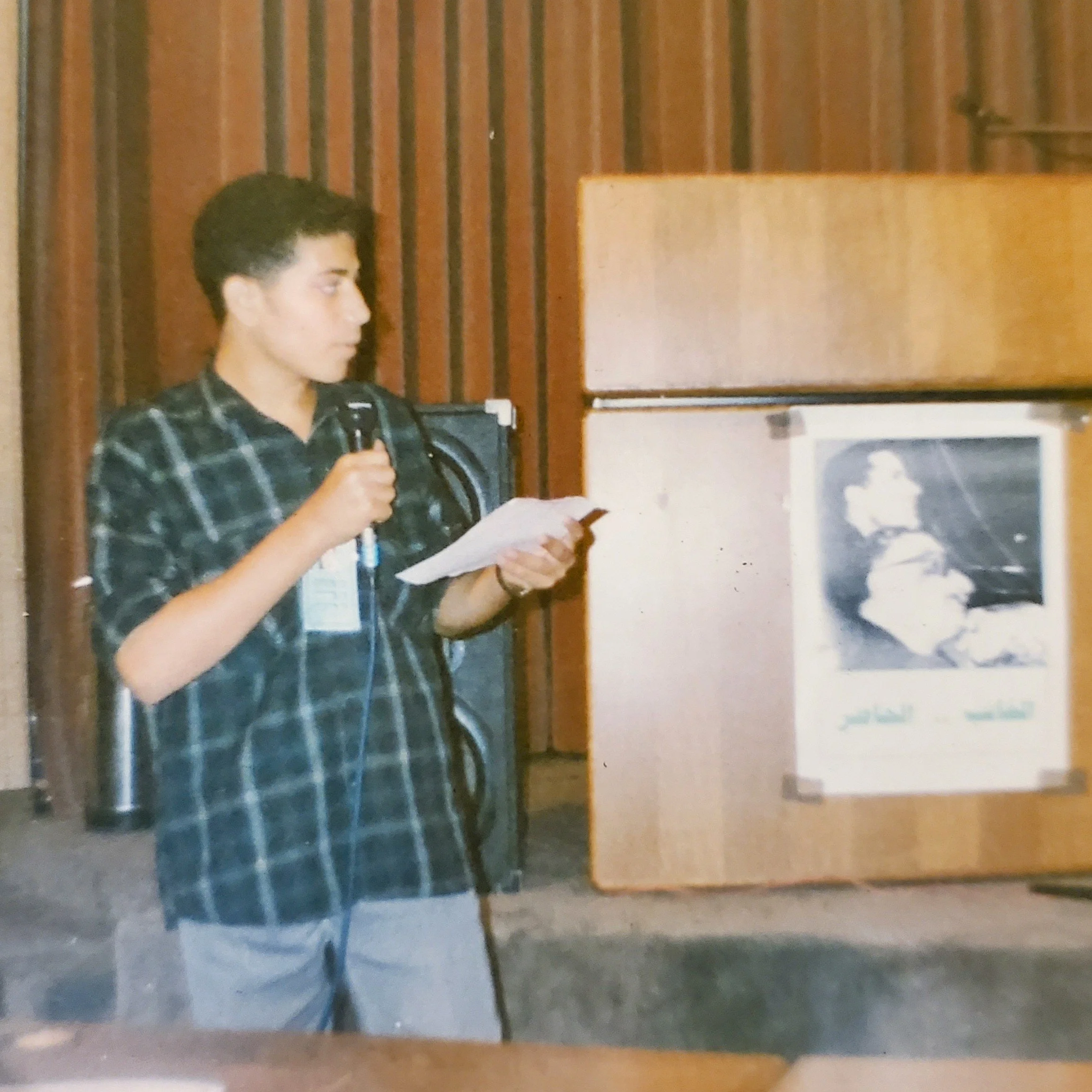
After this photo was taken, I folded the paper I was reading from and spoke my mind.
I started to read it. And somewhere in the first sentence, I stopped.
It wasn't a decision. It was more like my mouth refused. So I asked him something else. My own question. Unstaged. President Gaddafi had ruled Libya longer than I had been alive. No one would dare to oppose him, even in the very slightest.
"I remember walking down the stairs of the university meeting hall and seeing the horror in everyone's eyes."
Not anger. Horror. The look people get when they've just watched something that can't be taken back. They were afraid for me, afraid of me, and most afraid that they had been in the room of someone who defied Gaddafi.
"I remember seeing only my father among the many faces with a wide smile."
He wasn't smiling because I'd been clever. He was smiling because ten years earlier my mother had been right.
"I remember the cold touch of Gaddafi's hand. And the dead look in his eyes as I extended my hand to shake his with a smile."
"I don't remember ever reading remarks, including my own pre-written remarks, for anyone else after that."
I went home unharmed. Fifteen years later, the Libyan people revolted and killed Gaddafi.
But there was a room waiting for me in Cairo long before that.
THREE — AN INTERROGATION ROOM. LAZOUGHLI, CAIRO, 1997.
I came home from Libya, and a police officer knocked on our door. I was the one who opened it. He handed me a crumpled note, two inches of paper, with only my name on it.
They can't possibly be here to take me away.
That's what I thought. I was seventeen; I had just asked a dictator my own question, and I had not yet understood that this was the invoice.
My father argued with the officer about why I was being taken. It didn't work. So he told me two things.
Tell the truth. We did nothing wrong.
And: here is which bus to take to the interrogation complex.
He knew the route. They had held him in that same building ten years earlier — in the years he was suspended, the years my mother told him to follow his conscience.
They blindfolded me on arrival. And a national security officer asked me how come I didn't pray.
I asked him why my not praying was a national security matter.
I didn't get an answer. After three or four hours, they let me go.
That is the room where I learned the price, and that I could pay it.
FOUR — THE LIBRARY AUDITORIUM. ALEXANDRIA, 2004.
The library at Alexandria. The oldest library in the world, and the largest hall I had ever been inside at the time.
And coming down the stairs of that auditorium, alone, using a cane — Egyptian dictator Hosni Mubarak.
He was old and visibly unwell. Months earlier, he had fainted giving a live speech to Parliament on national television. He was walking those stairs by himself on purpose, so the country could see he still could.
He stopped a few feet from me to catch his breath. Our eyes locked. For a long few seconds.
"And I had a terrible thought."
"Would I expedite his demise by giving him a little push down the stairs?"
I won't pretend it was a flicker. It was a real thought, and I was a young man who had spent his adult life watching that man's police shoot at voters.
Here is what stopped me, and it wasn't fear.
"Before Mubarak took another step away, I had decided he does not deserve to die a hero."
If he falls down a staircase, he becomes a martyr, and a martyr's system outlives him.
"I would instead train thousands to expose his following fraudulent elections. And mobilize thousands to help peacefully oust him in shame, seven years later."
FIVE — A CHECK-IN ROOM. THE ISRAELI EMBASSY, CAIRO, 2004.
Later that same year. Palestinian President Arafat had just died and I'd been invited to observe the election to replace him. At the time I was running a national coalition monitoring Mubarak's own elections, so I knew exactly what I was going to be looking at.
I needed a visa. Which meant paying a visit to a heavily guarded building on the Nile.
I cleared Egyptian security with no problem. Then the Israeli metal detector beeped, and I reached into my pocket and pulled out a bullet shell.
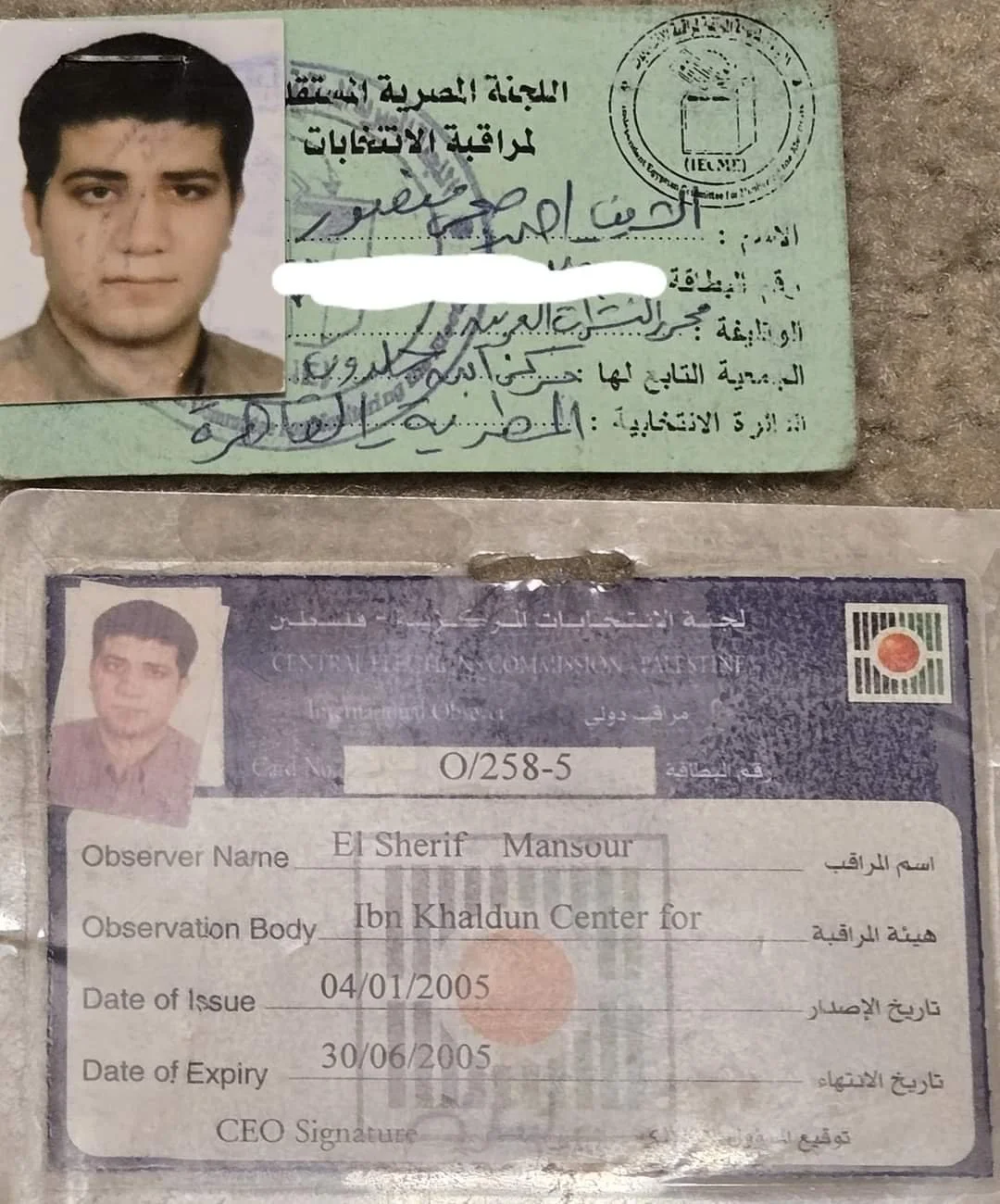
Observer ID for Egypt and Palestine
The soldiers quickly raised their guns and ordered me to put my hands up and put my pants down. They thought I was a suicide bomber.
It took me several seconds to remember how it got there.
The day before, an observer had travelled up from Upper Egypt to bring me spent shells — because the police had a practice. Shoot at opposition voters to frighten them away from the polling stations, while the local police bosses stuffed the boxes inside. He brought them to me as evidence. I put them in my pocket. I forgot to take that one out.
"To cut a long story short, I would walk out with the visa that day. But also that day, I stopped having anything to hide."
The thing that nearly got me shot wasn't a weapon. It was proof, in my pocket, that I'd forgotten I was carrying.
SIX — THE BEN FRANKLIN ROOM. WASHINGTON, D.C., FEBRUARY 2011.
In 2009, the Secretary of State had said publicly that she considered President Mubarak and his wife Mrs. Mubarak friends of her family. On the first day of the uprising on January 25, 2011, she told reporters the Egyptian government was stable. Two days later, the Vice President went on television, was asked whether it was time for Mubarak to stand aside, said no — and when asked whether the man was a dictator, said regardless if he was or not, he would not refer to him as one.
Thousands of Egyptians were killed before and after Mubarak finally resigned and was brought to court in shame.
Then here I am at the State Department. The Ben Franklin Room, which is exactly as gold as it sounds. Fifty American embassies watching. Secretary Clinton is launching an initiative about listening to civil society.
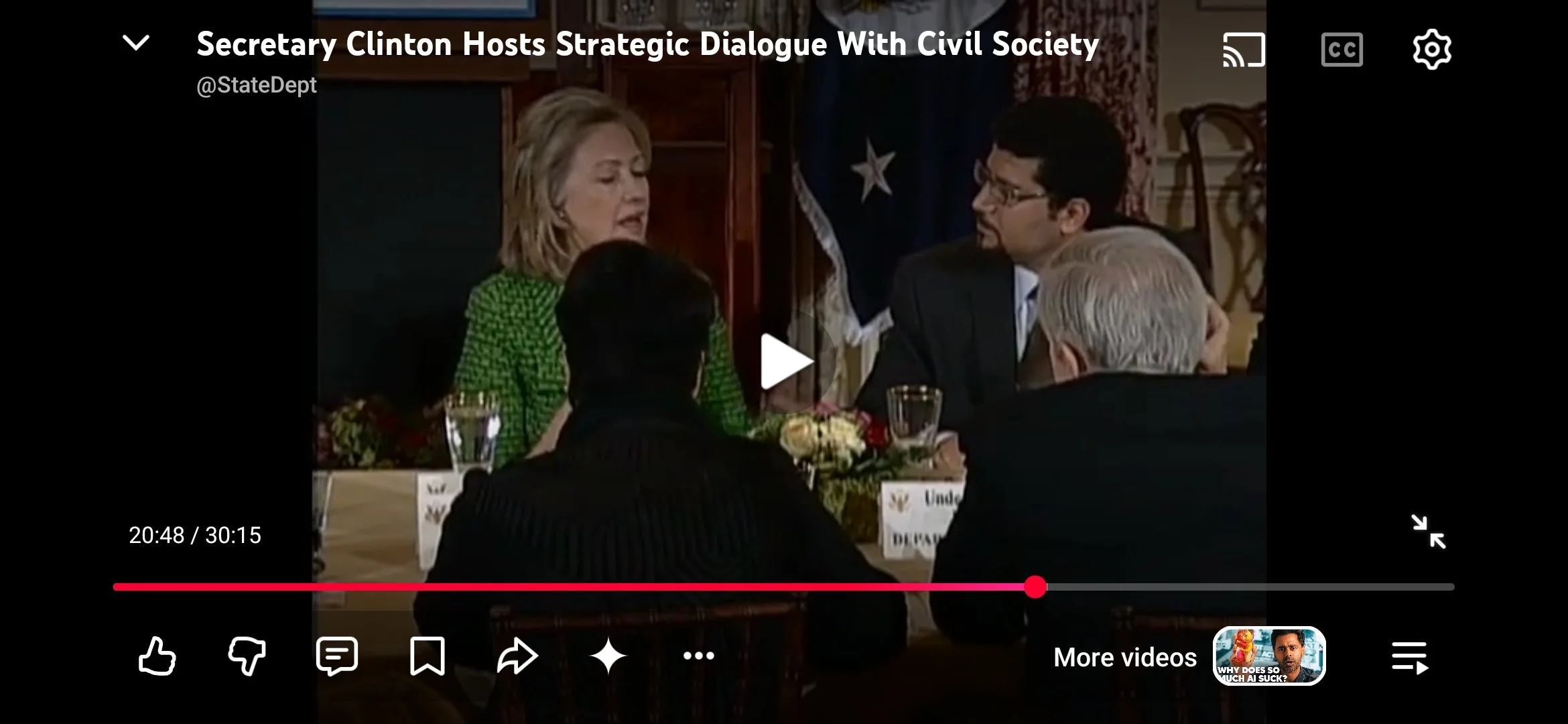
Five days after Mubarak resigned
And she calls on me first. By name. Says it's particularly timely for me to open the discussion.
That is the most powerful government on earth telling a young Egyptian he was right. I had about a minute of applause to decide what to do with it.
"I was very much expecting that all these nice words would come."
"Let's be honest. The record of the U.S. foreign policy on Egypt and on Tunisia is not very good."
Thirty years of American aid to Egypt, and civil society never received more than one percent of it. And in the three years just past, when it mattered most, the State Department had folded to Egyptian government pressure and restricted democracy funding to human rights groups that Egyptian security approves.
"I know that I'm being critical."
She told me she had already instructed every American ambassador to engage civil society. That it had been done.
There would be a cage waiting for me in Cairo a little more than a year later.
SEVEN — THE RATS ROOM. CAIRO AIRPORT, JUNE 2012.
Sixteen months later, that military government charged me. Forty-three of us, accused of running illegal organizations on foreign money. I was in Washington. They tried me in absentia and put me on the airport list as a fugitive.
Being tried in absentia feels like safety. It isn't. It means the people who couldn't leave — accountants, translators, local staff — sit in an iron cage in a courtroom while you sit at a desk.
I wrote what I was going to do four months before I did it, in public, under my own name:
"I simply cannot look myself in the mirror or think about facing my family and friends who have already sacrificed so much if I don't help prevent the revolution from being hijacked."
My own organization opposed it. My boss argued with me for weeks, and I told him something I've never taken back:
"If I don't go back, I won't be able to look my children in the eyes."
I did not have children.
I resigned so I could go. Flew EgyptAir into Cairo intending to hand myself in. They detained me on arrival and held me overnight before jail, in a room at the terminal with rats in it.
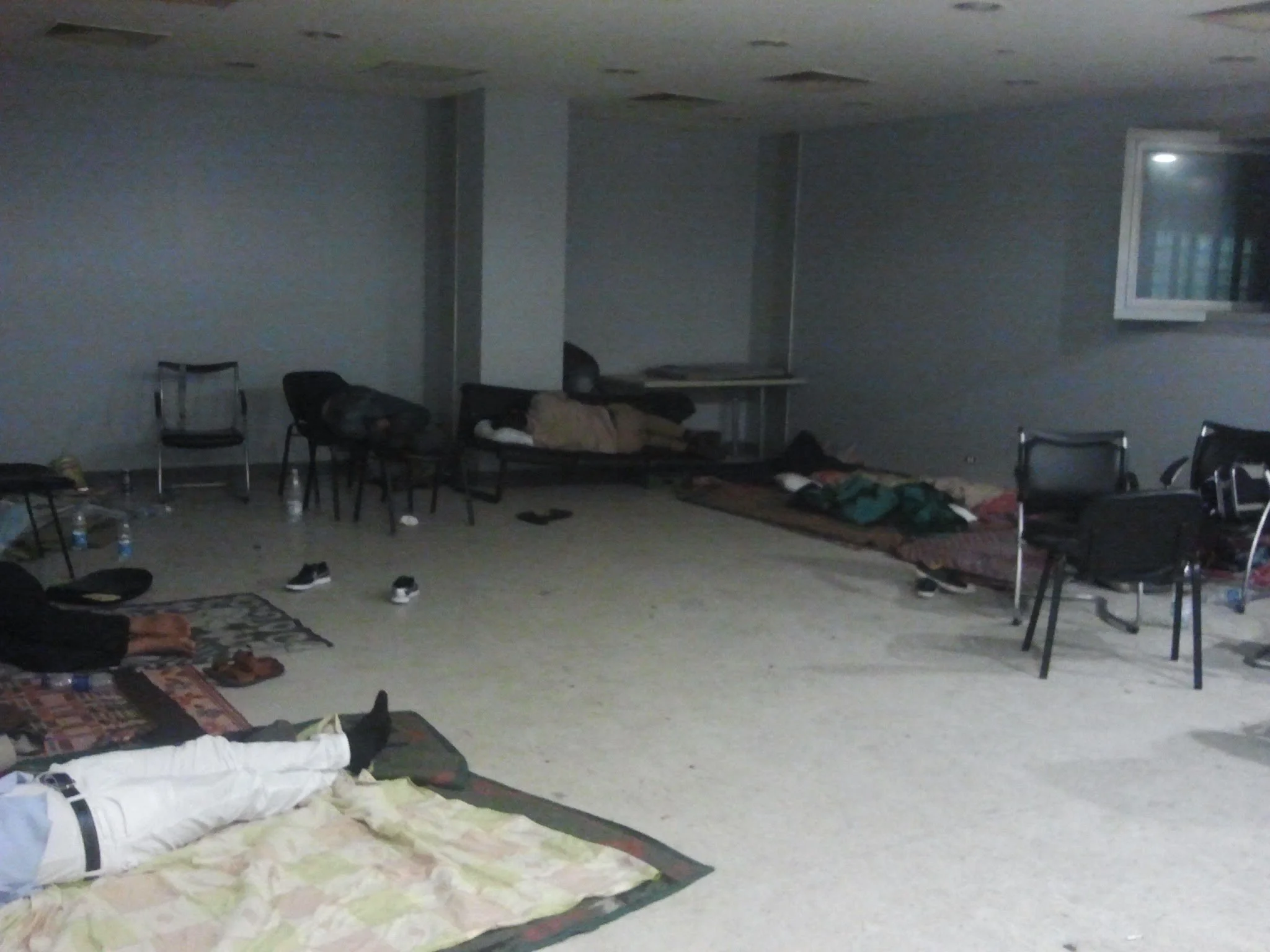
The Rats Room
In Arabic, the rats room is where you send a child who has disobeyed.
That's what they called it, and that's what I called it, from inside, along with four other words:
"Sun rises from behind bars."
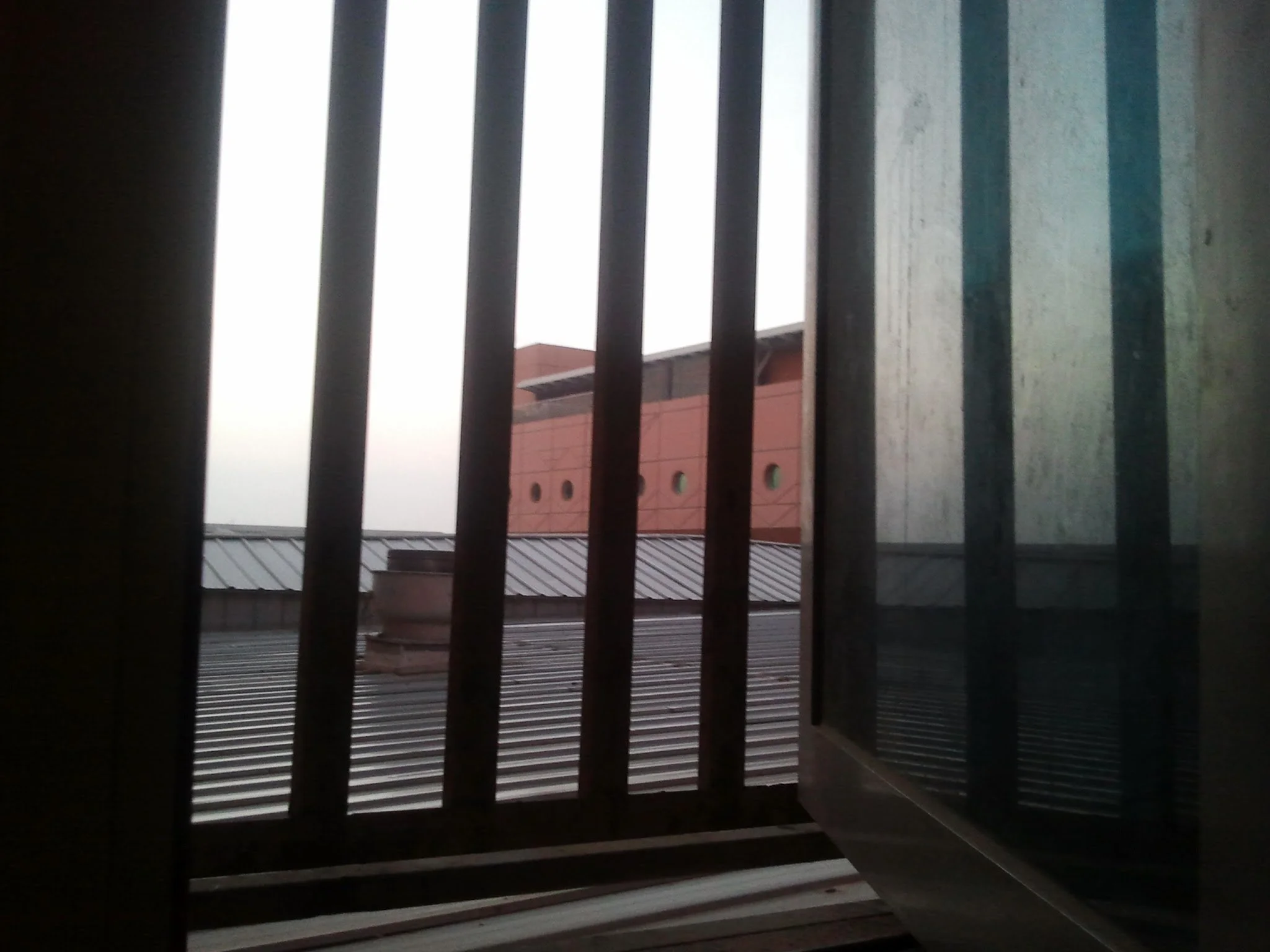
I stayed up all night and posted this photo to my Twitter account at 4:44 AM
The next morning they walked me into the courtroom in handcuffs, and dozens of my family and supporters erupted — chanting against military rule, in front of the judges of a military government.
I won. Released without bail the same day. Six more years to clear every charge.
People ask if I'd go back now, since the court says I can.
"They can always start another case against me."
EIGHT — A UNIVERSITY HALL AGAIN. HOWARD, NOVEMBER 2023.
Twenty-six years after Sirte, another university hall. Five weeks into the war on Gaza.
For most of my life the thing in my way had been a regime. In this room it was my own profession. Addressing a room full of young African American journalists, many of whom looked scared and anxious.
The host opened by naming the silence — that when journalists are killed, we normally roar, and this time we were quiet.
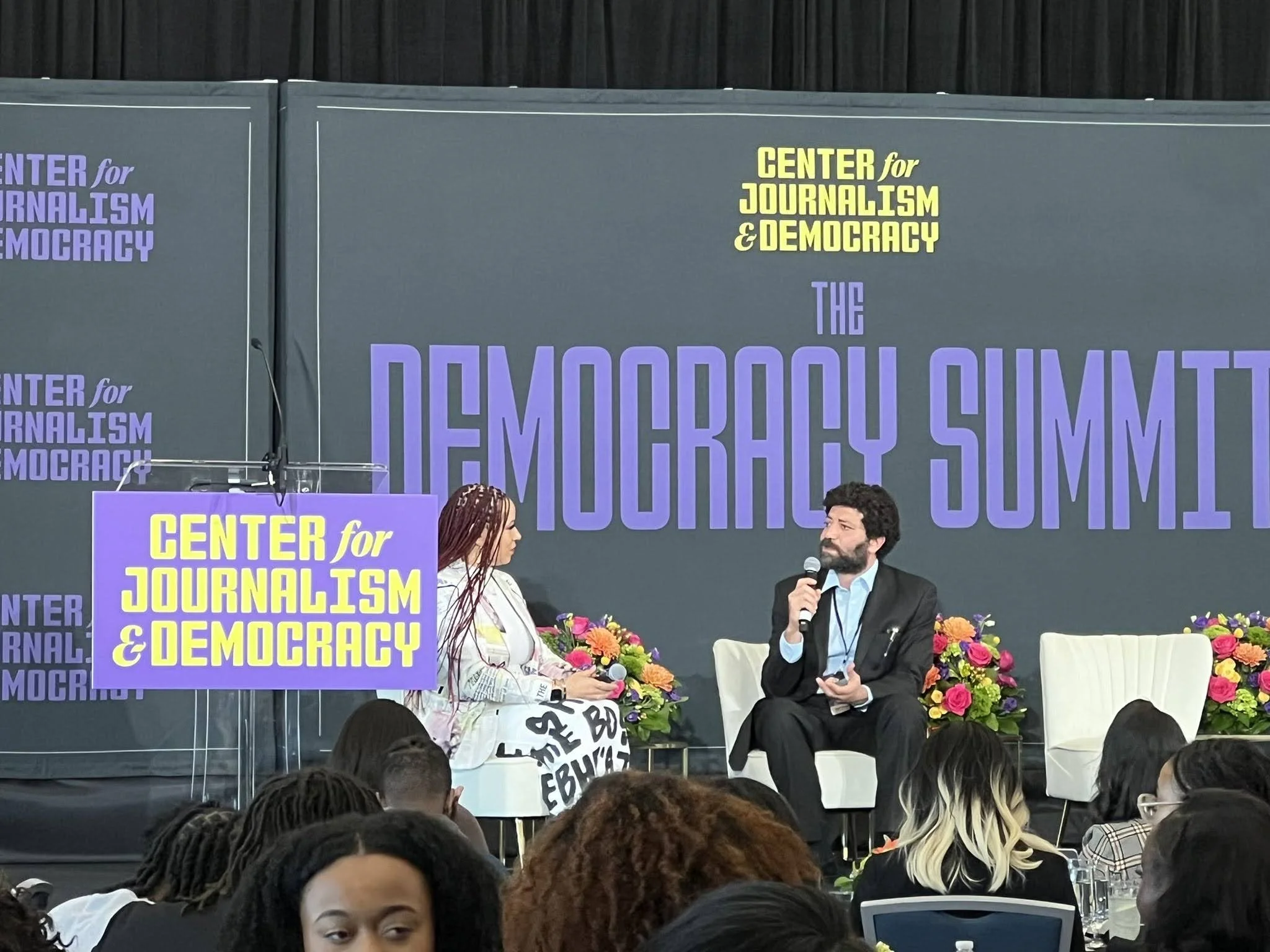
Confronting my own profession
"In many ways, the local Palestinian journalists are the ones who are paying that heavy toll."
"We talk about them as a firewall for democracy, but they're also an antidote to the fog of war."
Then she asked me directly whether the silence was racialized. And I said:
“It is not the journalist's job to stop tragedies,” but as an American, I am proud of the First Amendment right. "Freedom of speech is in the law and in the Constitution. You can fight for it. You can sue for it.”
A few months later, my employer put me on a performance plan.
NINE — THE NATIONAL PRESS CLUB. WASHINGTON, MAY 2024.
I was told to decline an invitation to a symposium memorial for Palestinian American journalist Shireen Abu Akleh, who was murdered by the Israeli army two years before. Her niece sat beside me on the panel.
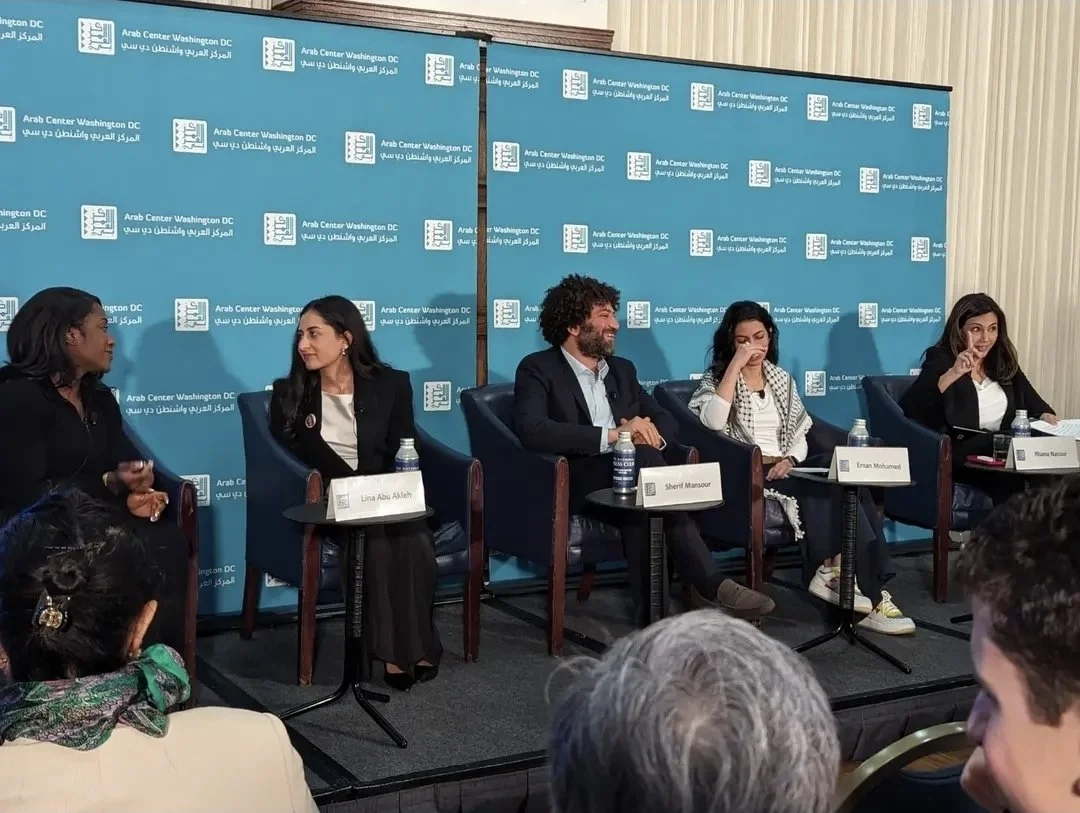
I went anyway with no institution beside my name.
“More journalists had been killed in the first ten weeks of the war on Gaza than had ever been killed in a single country in an entire year.”
That was my count. My framing. My words, read into that room, a few months after the organization that published them punished me for speaking up. So when my turn came, I said the thing I had not been permitted to say inside.
That institutional racism is at the core of how mainstream American media operates when it comes to Gaza. That the United States — a former settler-colonial apartheid state — is backing another settler-colonial apartheid state. That Israel must not be treated as an exception.
I have said it since on air, in journalism schools, in think tanks, in government offices, and around the world.
TEN — THE BARBICAN. LONDON, NOVEMBER 2024.
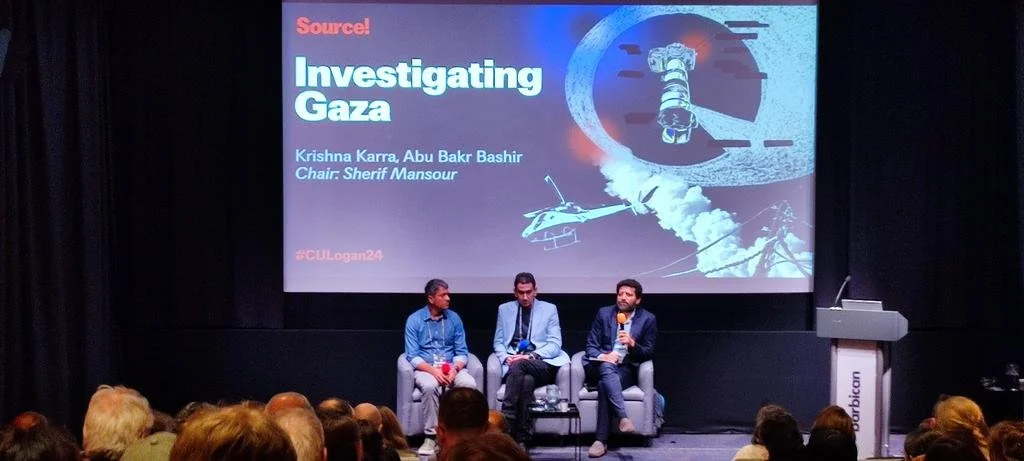
Seven months out. No job, no title, no institution behind me. An auditorium at the Barbican, the Centre for Investigative Journalism, a room full of the people whose profession I had just spent a year accusing.
"The mere fact is Palestinian journalists in Gaza did not choose to be there. They had no exit and no safe haven, and they were left to bear the brunt of the Israeli army fire — and to bear witness to all of us about what's happening there — while the rest of the international media not just ignored the suffering that they had, but showed an institutional bias, complicity."
"If you are going to not care about journalists being killed because of their background or because of their nationality, you are putting all journalists everywhere in danger. Impunity, like violence, does not have limits or boundaries — and like a virus, they do not respect borders."
"We need a reckoning in international media. We need to confront racism in international media. And that's the only way we can win the fight of censorship in Gaza and Tel Aviv — by winning the fight of censorship in Western capitals, including this one."
Everything here is on the record. Where a room rests on my own published account, it says so.
Rooms One and Three — Newsweek, 22 March 2021. The 1987 raid, my father's forty days, the summons at seventeen, Lazoughli.
Room Six — US Department of State transcript, PRN 2011/224, 16 February 2011. Every word I said in that room, and Secretary Clinton's reply.
Room Seven — Foreign Policy, 7 February 2012, written four months before I flew. The photographs are mine, taken at 3:29 and 4:44 on 4 June 2012.
Room Eight — Democracy Summit, Howard University, 14 November 2023.
Room Nine — Covering Palestine: A Shireen Abu Akleh Memorial Symposium, Arab Center Washington DC at the National Press Club, 9 May 2024.
Room Ten — Centre for Investigative Journalism, Barbican, November 2024.
Rooms Two, Four and Five are my own accounts, published previously.
