A conversation with Sudanese advocate Ilham Ibrahim
"Men Have a Common Agenda, and It Is Against Us"
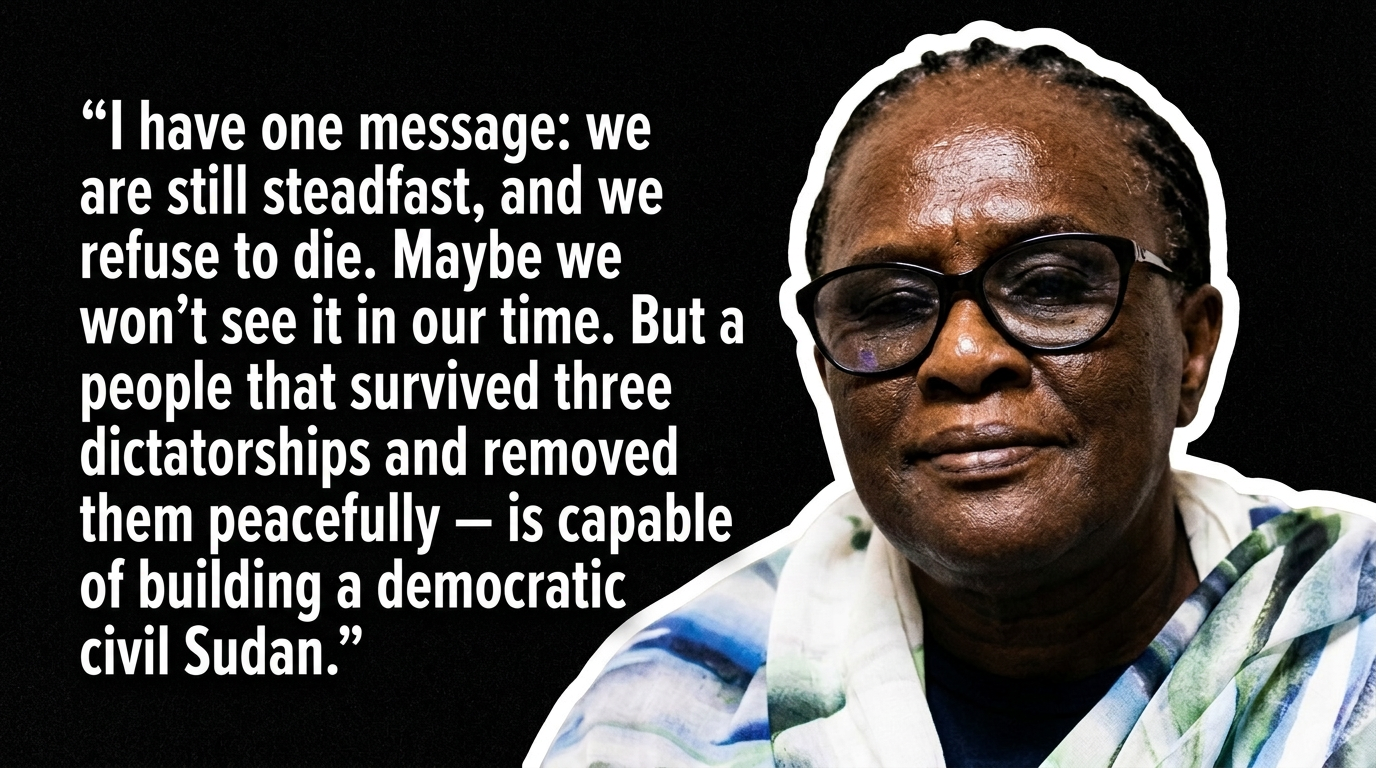
Ilham Ibrahim talked to me from Uganda on September 23, 2026
I started this podcast because I wanted to introduce you to people who inspire me personally and have chosen to partner with the Janoub Group consultancy firm.
Ilham Ibrahim is one of them.
She is the executive director of the Sudanese Organization for Research and Development — SORD — a feminist civil society organization founded in Khartoum in 2007 and now operating from eastern Sudan and outside the country, after its Khartoum office was looted on the first day of the war. I recorded this conversation in Arabic. This is an English summary. The audio episode on Sudan will be published on the Janoub Podcast at https://www.janoubgroup.com/podcast
On what Sudanese women actually said about peace
SORD went to speak directly with Sudanese women — grassroots women, rural women, women in communities — and asked them what peace means to them and to their families. The premise was simple: before talking about feminist peace or sustainable peace, set aside the elite assumptions.
"Women across all their different contexts — different ages, present in cities and rural areas, in eastern Sudan or western Sudan, employed or not, educated or not — all have their own understanding of peace," Ilham told me. "And it has nothing to do with the language that appears in peace agreements."
Peace agreements tend to have beautiful words. But when you try to translate them into programs, they don't touch the reality people live. Especially women, because their voices were never heard to begin with — they weren't part of the process. What women said they want: safety from violence at the family level, the community level, the state level. Education. Healthcare. Not the language of peace agreements. The substance of a life.
On why all previous peace agreements have failed
"All the previous processes failed to address the structural and systematic violence that has existed in Sudan for fifty or sixty years," Ilham said. "That is why we find ourselves signing another peace agreement after three years. And another after two years."
In every process — the 1971 agreements with the southern movements, the CPA in 2005, Abuja in 2006, Doha for Darfur — one thing remained constant: the systematic exclusion of those who have suffered most from the war. Women were either completely shut out or included in what Ilham calls "a cosmetic way" — present in corridors, in advisory roles, in consultations, but not at the table where decisions are made.
The Juba Agreement had women present. But mostly in what she calls the "track" outside the room — not at the negotiating table itself, not in the core drafting, but in the form of advice and consultations. Not real, effective participation.
On the unified feminist agenda
"Men have their own shared goals, and we must reach our common agenda as Sudanese women — regardless of our differences — otherwise we will never win." She knows the resistance to this from inside. Many women argue that a diversity of voices is the point, that women shouldn't be asked to have one agenda when men aren't. Ilham's response: "Men have a common agenda, and it is against us."
She has seen it in every process, including the revolution itself. Youth and women led the 2019 revolution. When the transitional institutions were formed, they were cut out. One woman on the Sovereignty Council. She was personally present at the Juba peace talks and was one of hundreds of women who participated in many workshops to design the law governing the Women's Commission. It was ready. It was one of the first laws submitted to the Council of Ministers. It was never activated — because of the masculine mentality that dominated throughout the entire transitional period.
The 1325 story
During one round of negotiations, UN Women arranged for Sudanese women to lobby by placing them in the corridors of the hotel where the talks were taking place — to try to reach negotiators and pass along questions. One of Ilham's colleagues approached a negotiator, a political figure from the revolution, and told him they were bringing the UN Resolution on Women, Peace, and Security, known as UNSCR 1325, to the negotiations.
His response: "1325 — what does that even mean? First time I'm hearing about it."
It turned out none of them had heard of it.
The women were told: we start from the minimum.
"I tell that story to show what the building looks like from the inside," Ilham said. "Exclusion itself is violence. The exclusion of half of Sudanese society from decisions about Sudan — that is violence. Direct, consequential violence. More than any other form. Because without meaningful representation of women in peacebuilding processes, there will be no lasting peace in Sudan."
She was categorical about every current mediation attempt: "They're all built on the same idea. Bring this party, bring that party, exclude civilians, exclude women. And we call that peace. All previous agreements are headed for the recycling bin unless peace is built from the bottom up."
On how the international coverage gets it wrong
SORD does not want to be the subject of international community reports in the way those reports are usually written.
"We are not only victims," Ilham said. "We need solidarity, yes, but we are steadfast. Sudanese women are steadfast."
What SORD provides instead: material built on stories, on women's daily experiences — not aggregate numbers, but the specific gap between how much humanitarian aid was announced and how much actually moved. Not victimhood as the frame. Resilience as the frame — with evidence.
"Women are forming mutual support groups, trying to break the stigma around sexual violence, helping each other, using the nafeer tradition to pool resources despite poverty and displacement. Women are now the primary breadwinners more than men. I say that with evidence."
And on the Inqaz period — former Sudanese President Bashir's three decades: "That was the period of the greatest exclusion of the feminist movement in Sudan. There were attempts to push women back to being housewives, to staying home. All the gains of the Sudanese feminist movement from the 1950s and 1960s were rolled back during the Inqaz period."
Her closing
"I have one message: we are still steadfast, and we refuse to die. Maybe we won't see it in our time. But A people that survived three dictatorships and removed them peacefully — is capable of building a democratic civil Sudan."
"Sudan 1.5: GBV, Shared Healing, and Women-Led Accountability Across Sudan, Libya, and Yemen"
Janoub Group & the Sudan and Uganda-based SORD (Sudanese Organization for Research and Development) launched this initiative to bring Sudanese women human rights defenders (WHRDs) into dialogue with women peace leaders from Libya and Yemen — contexts where similar patterns of weaponized sexual violence, institutional collapse, and women's exclusion have played out — to build shared insight, collective healing, and a regionally-grounded accountability track.
Partners come from Sudan, Uganda, Ethiopia, and Egypt, in addition to experts from Yemen, Libya, and Syria.
More info at: https://www.janoubgroup.com/projects
